


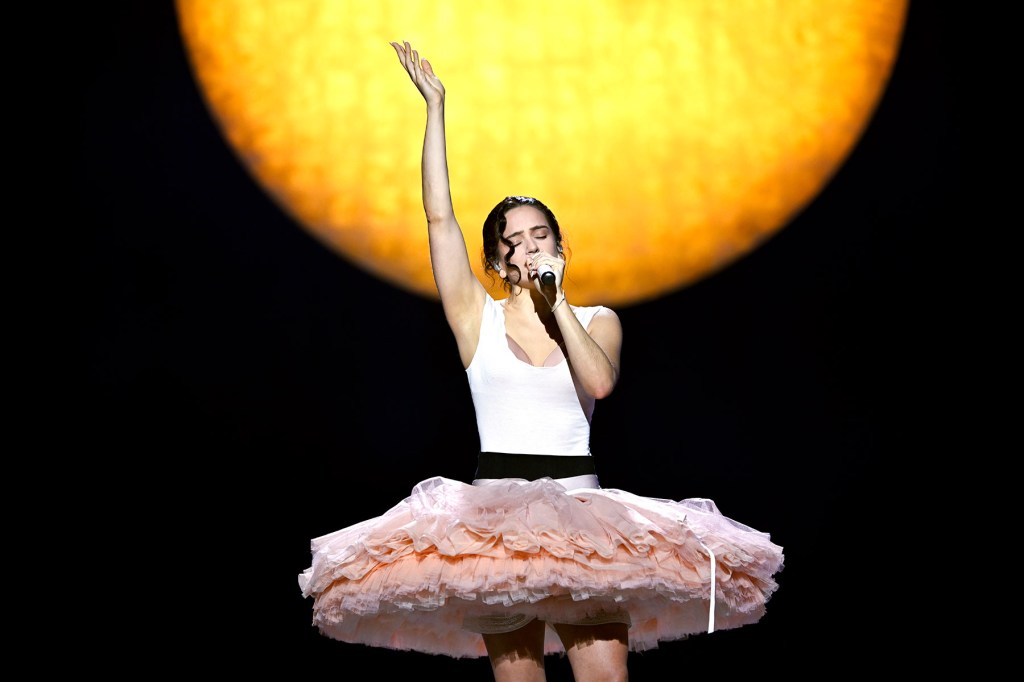
When Rosalía brought the LUX Tour to Madison Square Garden on Tuesday night (June 16), she unveiled one of the year’s most fully realized pop spectacles on one of its grandest stages. By the time she reached New York for the first of two nights at MSG, the tour had already established itself as her most ambitious live production yet. The roughly 24-song performance leaned into the visual language of ballet, medieval opera, Spanish flamenco and techno while never losing sight of the emotional intensity that has made her one of the most compelling performers of her generation.
That tension — between the monumental and the intimate, the sacred and the irreverent, the rigorously choreographed and the instinctively felt — was what made LUX such a fascinating live proposition in the months since its March debut in Lyon.
Backed by a classical orchestra, Rosalía moved through the show as ballerina, nightclub instigator, confessional penitent and winged angel. Religious and art-historical imagery ran throughout, from a Degas-inspired opening reveal to the white headpiece associated with the 2025 album’s iconography, while the setlist made room for both theatrical grandeur and crowd-pleasing release.
The Garden stop also arrived with added emotional weight. After postponing several North American dates due to a family emergency, the Spanish superstar returned to the stage in Boston last week and told the crowd that “loved ones need to come first,” adding more resonance to a show centered on devotion, vulnerability and transformation. And at Madison Square Garden, Rosalía made good on the scale of that vision.
From her jaw-dropping entrance to a surprisingly funny New York-specific confessional cameo to a finale that turned the stage into a startling religious image, Rosalía’s first of two nights at MSG delivered no shortage of visuals and musical turns worth holding onto. Here are the five best moments from Rosalía’s first Madison Square Garden show on the LUX Tour.


-
She Opened the Show Like a Magic Trick

Image Credit: Gareth Cattermole/Getty Images for Live Nation Rosalía didn’t so much walk onstage as materialize. In one of the night’s most arresting opening images, she appeared boxed in and then dramatically unveiled, as if the show were beginning with a sleight of hand. The crowd roared the second she emerged, and for good reason: her delivery was both pristine and bizarre, theatrical in a way that immediately announced that LUX would not be operating on regular arena-pop terms.
Dressed in a ballet-inspired look, the effect was elegant, but never precious. It was one of several reminders throughout the night that Rosalía has the kind of command that lets her pull from high art without ever becoming stiff or overly reverent. Even in its prettiest moments, her performance retained an unruly pulse.
That opening also established one of the evening’s central pleasures: watching her filter discipline through instinct. Ballet became less a symbol of delicacy than one of control, precision and transformation. In her hands, even a classical silhouette looked charged with danger.
-
The Costume Changes Told Their Own Story

Image Credit: Gareth Cattermole/Getty Images If one wanted to make the case that Rosalía’s wardrobe deserved its own byline, Tuesday night’s show offered plenty of evidence. Her costume changes weren’t just visually stunning — though they certainly were that — but crucial to the arc of the performance. Each new look helped mark another turn in the emotional and aesthetic logic of LUX, as she shapeshifted from ballerina to black-swan seductress to near-saintly figure.
One especially memorable sequence paired velvety pink and beige drapery with a song that nodded to Dido’s “Thank You” — the same melody famously repurposed in Eminem’s “Stan.” Against all that softness, the superstar moved with unnerving focus, giving the moment a dreamlike richness that felt lush rather than sentimental. Later, she leaned into a darker register, morphing into something more severe and almost feral, the kind of transformation that made the night feel not just staged but narratively composed.
That commitment to visual reinvention is part of what made the show so gripping. Rosalía changed the temperature with every outfit change in between sections. By the time she moved into the more aggressive, body-driven sections of the set, the clothes had already helped signal the shift. They clarified mood, sharpened character and kept the audience watching for what she might become next.
-
Her Madison Square Garden Speech Gave the Spectacle More Heart
For all of LUX’s grand symbolism and theatrical rigor, one of the night’s most affecting moments came when Rosalía simply talked to the crowd. Reflecting on her long relationship with New York, she told fans she had been coming to the city for more than a decade, dating back to her earliest project, Los Ángeles (2017), and remembered playing one of her first local shows for roughly 20 people. Now, standing inside Madison Square Garden for the first of two nights, she seemed both stunned and very grateful by the scale of the full-circle moment.
“I am so thankful to be back here. I’m in love with the city — I’ve been in love with it since the first time I came here,” she said in between songs. “Thank you for bringing me back. More than a decade I’ve been coming here, from my very first project, Los Ángeles, right up to today. I remember one of the first shows here — and I’m not exaggerating — there were 20 people. And tonight I am playing Madison Square F–king Garden! It’s a big deal for me. It’s crazy, so thank you so much for having my back. I will perform with all the love I have. I do this with all my love, and hopefully there will be something here that you will be able to take with you. Esto le da sentido a lo que hago (This gives meaning to what I do).”
-
Maggie Rogers’ Confessional Cameo Brought the Night Back to New York
Among the show’s most unexpected delights was a confessional-booth cameo from Maggie Rogers, who appeared during one of the evening’s theatrical interludes and instantly gave the Garden a moment that belonged specifically to New York. In keeping with the show’s religious iconography, Rosalía played priest as Rogers delivered a funny, sharply told story involving a date with a man who claimed to work at The New York Times — only for her to later learn he was actually her friend’s boyfriend. “New York Times journalist? You just cannot trust them!” she quipped, drawing one of the night’s biggest laughs.
The cameo worked not only because it was surprising, but because it fit so neatly inside Rosalía’s world-building. LUX has room for the sacred, the sensual and the absurd, and the confessional segment captured that balance perfectly. It was campy, intimate and site-specific all at once.
-
She Turned a Pop Cover and the Finale Into Living Art

Image Credit: Sharon López One of the evening’s most striking tableaux came when Rosalía performed “Can’t Take My Eyes Off You” — first made famous by Frankie Valli in 1967, and memorably covered by Boys Town Gang in 1982 and Lauryn Hill in 1998 — poised almost perfectly still inside a gold frame, as if she herself had become a portrait. Wearing an off-white silk dress with standout red silk gloves, her wavy hair spilling softly over the edge of the frame, she delivered the song with a more restrained, pensive sensibility than one might expect from such a familiar standard. And true to the song’s title, it was almost impossible to look away.
The image distilled much of what made the show so effective. Where other artists might push a cover like this toward crowd-pleasing excess, she found something subtler and stranger in it.
As the show neared its close, the orchestra became part of the architecture of Rosalía’s vision, not merely accompaniment. Rosalía made her way into the orchestra’s separate stage area, and an overhead camera revealed a stunning new perspective: the stage formed the shape of a lit-up cross. It was the sort of final image that instantly reframed everything that had come before — the confessional, the devotional language, the saint-and-sinner iconography, and the sense of ritual embedded throughout LUX.



Comentarios